Siamese Cat: Personality, Modern vs. Thai Type, Care and Price
Cat Breeds 5 min read reviewed November 2026, 5 sources
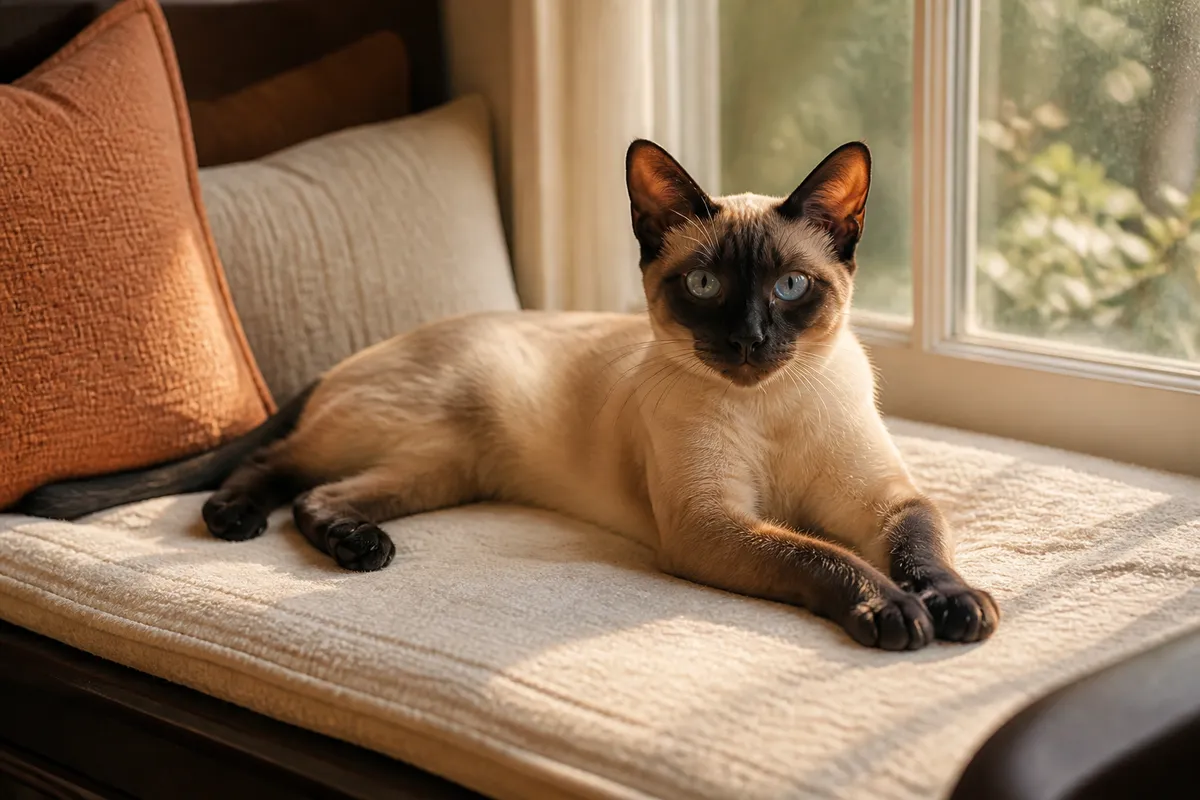
The Siamese cat is the talkative, blue-eyed, pointed breed from Thailand, famous for strong opinions, a loud voice and deep attachment to its people. Grooming is easy, but company is not optional: a Siamese wants to be involved in your life all day, and comes in two quite different looks, the slender modern show type and the rounder traditional type known as the Thai.
Where the Siamese comes from
Pointed cats from what is now Thailand appear in a historic collection of Thai cat poems from the Ayutthaya period (1350 to 1767). In Thailand the traditional breed is called the Wichienmaat.
The first Siamese recorded in the United States, named Siam, was a gift to President Rutherford B. Hayes in 1878 from the American consul in Bangkok. In Britain, Siamese drew crowds at Crystal Palace cat shows in the late 1800s, and the Cat Fanciers' Association recognized the breed at its founding in 1906.
Siamese personality: loud, loving and a little clingy
Siamese are active, affectionate, loyal and famously vocal. Their range of sounds includes one that resembles a crying baby, and they use it to comment on everything: your schedule, the food, the closed door, the existence of Tuesday. If you want a quiet cat, this is not your breed.
They want close contact, seek out warm laps and will protest loudly when ignored. Many Siamese bond strongly with one or two people and follow them from room to room. They are determined climbers who need sturdy cat trees and shelves, and they often do best with a companion cat, ideally another Siamese or a similarly social breed.
The flip side is that Siamese can struggle when left alone a lot. Anxiety may show up as over-grooming, and young Siamese are prone to wool sucking and chewing non-food items.

Modern vs. traditional Siamese: what is a Thai cat?
After World War II, Siamese breeding for shows moved toward a slimmer body and a longer, wedge-shaped head. Today's CFA standard calls for a long, flat profile, a wedge-shaped head, very large ears and almond-shaped blue eyes on a slender, long body.
Some breeders preferred the older, rounder look and kept it going. That traditional type is recognized by The International Cat Association and European registries as the Thai, also called the Old-Style Siamese. In the US you'll also hear "applehead," a casual term with no official definition. Personality is similar in both types: social, chatty and people-focused.
| Feature | Modern Siamese | Thai / traditional |
|---|---|---|
| Body | Long, slender, fine-boned | Medium, firm, more muscular |
| Head | Long wedge, flat profile | Rounder, softer wedge with a fuller muzzle |
| Ears | Very large, continuing the wedge | Large but set more on top of the head |
| Eyes | Almond-shaped, deep blue | Larger, rounder, blue |
| Registries | CFA, TICA and others as Siamese | TICA and European registries as Thai |
Siamese colors
All Siamese are pointed: a pale body with darker ears, face mask, legs and tail, and blue eyes. The CFA recognizes four classic colors. Seal point is the original and still the most popular, blue point was recognized in 1934, chocolate in 1952 and lilac in 1955.
Other registries accept more point colors and patterns, such as lynx (tabby) points; those are covered in the guide to Siamese point colors. Points darken with age and in cooler body areas, so kittens are born pale and develop their markings over the first months.
Grooming and daily care
The coat is short, fine and low-maintenance. A quick weekly comb or a rubber brush, even just your damp hands, removes dead hair, and Siamese rarely need baths.
The real care work is attention and enrichment. Plan for daily play, climbing space, puzzle feeders and someone around for a good part of the day, or a second cat. Siamese are slender by nature, so keep them that way with measured meals; ask your vet about portions for each life stage.
- Weekly comb or rubber brush
- Two play sessions a day, especially fetch and wand toys
- Tall, sturdy cat trees and window perches
- A companion cat if you work long hours
- Regular dental checks at the annual vet visit
Siamese health problems
Siamese are generally long-lived, often about 12 to 15 years or more, but several inherited and breed-associated conditions are known. Ask the breeder about all of these.
- Progressive retinal atrophy (PRA): an inherited eye disease that leads to vision loss. It's recessive and can be detected with a DNA test.
- Amyloidosis: abnormal protein deposits that can damage the liver. No gene test exists, so breeders track it in their lines.
- Asthma: International Cat Care lists asthma as more common in Siamese and related breeds.
- Other conditions listed for the breed include mediastinal lymphoma, pyloric stenosis (a stomach outflow problem) and strabismus (crossed eyes).
- Behavior-related: psychogenic over-grooming and wool sucking, often linked to stress or boredom.

Siamese kittens for sale: price and finding a breeder
Siamese prices vary by breeder, region, type (modern or Thai), color and pet versus breeding rights, and there's no official figure. Look for a breeder registered with a major association who can show PRA test results for the parents and talk openly about amyloidosis and asthma in their lines.
Follow the CFA's scam warnings: avoid sellers with many litters at once, kittens offered at six to eight weeks, large nonrefundable deposits or pressure to ship without meeting. Kittens should go home at 12 weeks at the very least, with 16 weeks preferred. Many "Siamese" in shelters are pointed domestic cats or Siamese mixes, which share the looks and often the voice, and are well worth adopting.
Who a Siamese suits, and who it doesn't
A Siamese is perfect for people who want an interactive, talkative companion and are home a lot, for multi-cat households and for anyone who likes a cat with a big personality.
Apartment living works fine if you plan for it. A Siamese doesn't need a big home, but it does need vertical space, a window with a view and a predictable routine. Feeding at fixed times instead of whenever the cat yells, plus a solid play session before bed, keeps the early-morning concerts shorter, which your neighbors will appreciate.
It's a tough match if you need quiet (thin walls, a light sleeper, a baby who naps), if you're away long hours with no other pet, or if you'd prefer a cat who's content to be left alone.
Before you commit, spend an afternoon with an adult Siamese, at a breeder's home or a shelter. Ten minutes with a kitten tells you nothing about the volume of a grown cat who wants breakfast.
Frequently asked questions
How much does a Siamese cat cost?
It depends on the breeder, region, type and whether it's a pet or breeding cat, and there's no official price. A reputable breeder includes health testing, vaccinations and socialization. Adopting a pointed shelter cat costs far less.
Why are Siamese cats so loud?
Vocal communication is part of the breed's personality. Siamese use a wide range of sounds, including a baby-like cry, to ask for attention, food and company. If a Siamese suddenly gets louder, a vet check is still a good idea.
What is the difference between a Siamese and a Thai cat?
The Thai is the traditional, rounder type of Siamese, recognized separately by TICA and European registries. The modern Siamese has a longer, wedge-shaped head and a slimmer body. Both are pointed with blue eyes.
Are Siamese cats good with kids?
Usually yes, if the kids are respectful. Siamese are social, playful and enjoy busy households, though they want attention on their own terms.
Do Siamese cats shed?
Only a little. The short, fine coat needs just a quick weekly comb.
Why are Siamese kittens born white?
The point coloring is temperature sensitive. Kittens are born pale and develop darker points on the cooler parts of the body, ears, face, legs and tail, over their first weeks and months.
Sources
- Siamese breed profile, Cat Fanciers' Association
- Siamese, VCA Animal Hospitals
- Thai, Governing Council of the Cat Fancy
- Inherited disorders in cats, International Cat Care
- Could This Kitten Be A Scam?, Cat Fanciers' Association
Last reviewed: November 2026