Why Cats Meow: What Your Cat Is Really Telling You
Behavior 5 min read reviewed November 2026, 3 sources

Cats meow mostly to talk to people: adult cats rarely meow at each other, so that meow at your feet is a message meant for you, usually about food, attention, a closed door or a greeting. Most meowing is normal, but a sudden change in how much your cat talks deserves a closer look.
Why do cats meow at humans but not at other cats?
Kittens meow at their mother when they're cold, hungry or lost. Once cats grow up, they mostly drop the meow among themselves and switch to scent, body language, touch and the occasional hiss or growl. Adult cats do yowl at each other, mainly during breeding season, but the everyday meow is largely reserved for us.
The likely reason is simple: it works. Humans are bad at reading a slow blink, an ear angle or a tail position, but we reliably react to sound. A cat who meows near the food bowl and gets fed learns fast. Over months and years, many cats develop a private vocabulary with their household, which is why your cat's dinner meow may sound nothing like the neighbor cat's.
So when your cat meows at you, take it as a compliment of sorts. You've been identified as staff, and staff gets verbal instructions.

The most common reasons your cat meows
Almost every meow falls into a handful of categories. Once you know them, you can usually figure out the request from the time of day and where the cat is standing.
- Greeting: many cats meow when you come home or when you talk to them.
- Attention: cats left alone for long stretches often meow more to ask for contact or play.
- Food: meowing around mealtimes, or whenever someone walks into the kitchen, is the classic.
- Doors: meowing is a cat's main way to ask to be let in, let out or let into the one room you just closed.
- Mating: unspayed females in heat and intact males are far more likely to yowl.
- Something is wrong: an empty water bowl, a dirty or blocked litter box, discomfort or pain.
Types of meows and cat noises, decoded
Cats don't have a dictionary, and each cat's sounds are a little personal. Still, some patterns show up in most homes, and context matters more than the exact pitch. Watch the body language that comes with the sound: a raised tail and a relaxed face mean something very different from flattened ears.
If you're curious about the gadgets that promise to translate meows into English, that's a topic of its own. Your own notebook and a week of observation usually beat any app.
| Sound | What it often means | What you can do |
|---|---|---|
| Short, quick meow | Hello, or a casual check-in | Say hi back, a quick pet if she wants it |
| Repeated, insistent meows | Request: food, door, play | Check the basics, then respond on your schedule, not hers |
| Drawn-out, low meow | Complaint or demand | Look for the cause: closed door, empty bowl, dirty box |
| Chirp or trill | Friendly greeting, "follow me" | Follow, she's probably showing you something |
| Yowl | Mating behavior, territorial stress, or distress | Consider spay/neuter; if new or unexplained, call the vet |
| Hiss or growl | Fear or warning | Give space, don't reach for her |
| Purr | Usually contentment, sometimes self-soothing | Notice the context; purring has its own reasons |
Why does my cat meow so much?
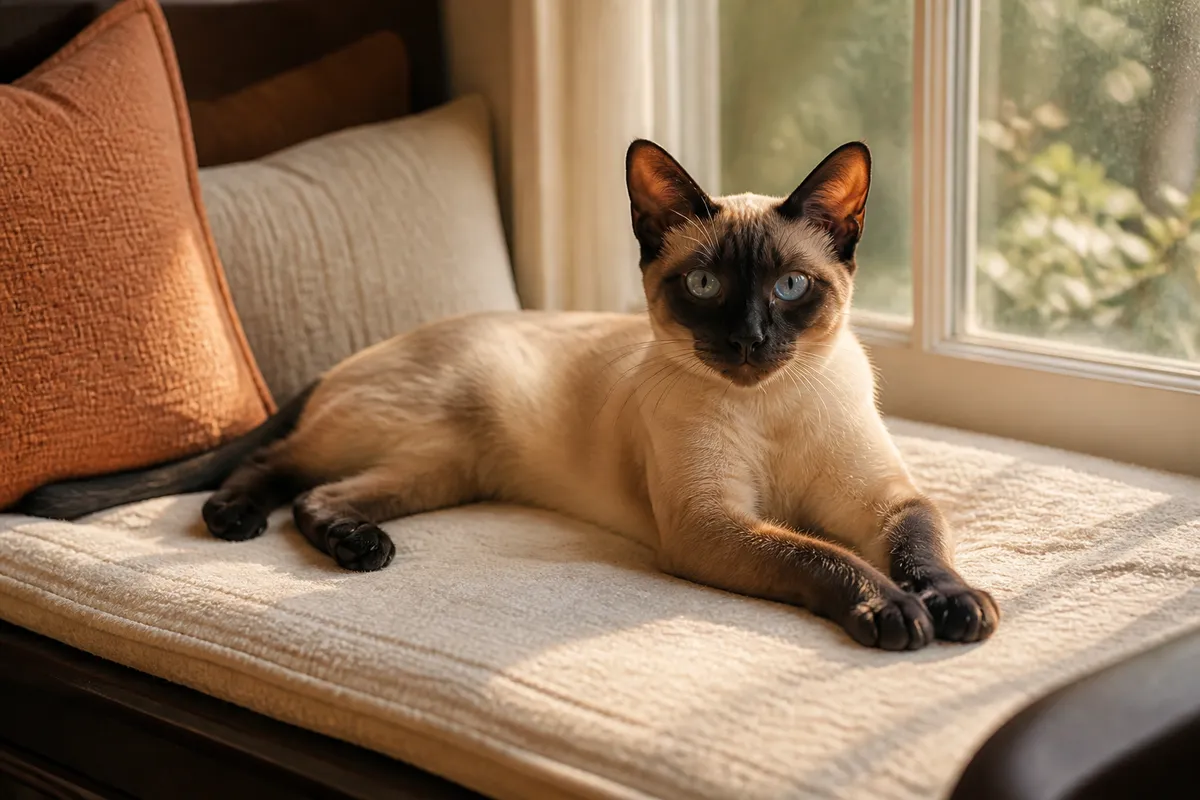
Whether meowing is "too much" is partly a personal judgment, since every cat meows to some degree. Some breeds are famously chatty, the Siamese above all, and owners of those cats sign up for conversation as part of the deal.
Outside of breed, the most common driver is learning. Cats discover that meowing earns a response, and for some cats even being scolded counts as a win because any attention is better than none. Other triggers include boredom, a new stray cat outside the window, a move, a new pet, a disrupted routine or grief after losing a companion. Meowing caused by a big change usually settles within a few weeks.
Hormones play a big role too. An unspayed female in heat can meow and yowl for days, and an intact male may pace and call when he smells a female nearby. Spaying and neutering are the most reliable fixes; the details are covered in the guide to a cat in heat.

Excessive meowing: when it's a health issue
Any cat who suddenly meows a lot more than usual should get a vet exam. Several diseases can make cats unusually hungry, thirsty, restless or irritable, and the extra noise is often the first thing owners notice. In older cats, an overactive thyroid and kidney disease are two common culprits, and both have their own detailed guides.
Senior cats who are losing their hearing can also become noticeably louder. Cognitive dysfunction, the feline version of age-related confusion, can cause meowing when a cat feels disoriented, often at night. Discomfort and pain are other possibilities. A vet can check for these and discuss what helps.
Go sooner rather than later if the meowing comes with other changes: eating or drinking more or less, weight loss, hiding, litter box problems or straining. Straining in the litter box is always a reason to call the vet the same day.
How to stop a cat from meowing at night or for attention
Once the vet has ruled out a medical cause, the goal is to make quiet more rewarding than noise. Expect the meowing to get worse for a few nights before it gets better. That's the cat testing whether the old rules still apply.
Start a simple log for a week: when does she meow, where, and what makes her stop? Patterns jump out quickly, and they tell you which of the steps below matter most.
- Don't reward the meow: no talking, feeding or petting while she's yelling, especially at night.
- Reward quiet: give attention during a calm pause, even a short one, and wait for silence before you put the bowl down.
- Feed on a fixed schedule, not on demand. An automatic feeder in another room takes you out of the equation at 5 a.m.
- Schedule play: a real play session before bed, ending with a small meal, uses up the energy that powers night concerts.
- Add enrichment: puzzle feeders, window perches and rotating toys for cats who are home alone all day.
- Check the basics daily: fresh water, a clean litter box and access to it.
- Protect your sleep: earplugs and a closed bedroom door are fair game while you retrain.
What not to do when your cat meows
Don't ignore every meow on principle. Unless you're sure she's just angling for a second breakfast, take a quick look: the water bowl may be empty, a door may have closed on the litter box, or she may be stuck somewhere.
Never scold, spray or hit a meowing cat. It's unlikely to stop the noise and can make her fearful of you, which creates new problems. If you've tried consistent retraining for several weeks and nothing changes, ask your vet about a referral to a veterinary behaviorist.
"The cat's meow": where the phrase comes from
Calling someone "the cat's meow" means they're excellent or extraordinary. It's American slang first recorded in the early 1920s, the Jazz Age, when animal-themed compliments were all the rage among the young and fashionable.
Your actual cat, of course, considers the phrase a literal job description.
Frequently asked questions
Do cats meow at each other?
Adult cats rarely meow at each other. Kittens meow at their mother, and adults yowl at each other mainly during breeding season, but day to day they communicate with scent, body language and touch. The meow is mostly aimed at people.
Why does my cat meow at me when I come home?
Usually it's a greeting, often mixed with a reminder that dinner exists. Many cats meow when their people arrive or talk to them. If she also rubs against you with a raised tail, it's a friendly hello.
Why does my cat meow at night?
Common reasons are hunger, boredom, a learned habit of being rewarded, or outdoor cats outside the window. In senior cats, hearing loss and cognitive dysfunction can cause nighttime meowing too. Rule out medical causes first, then use play before bed, scheduled meals and no rewards for night meowing.
Is it bad if my cat suddenly meows a lot more?
A sudden increase is worth a vet visit, especially in an older cat or if eating, drinking, weight or litter box habits have changed too. Conditions such as an overactive thyroid, kidney disease or pain can show up as extra meowing.
Why do some cats barely meow at all?
Some cats are naturally quiet, and some breeds and individuals simply talk less. If a quiet cat has always been quiet and is otherwise healthy, there's nothing to worry about. A normally chatty cat who goes silent and seems unwell should be seen by a vet.
What does "the cat's meow" mean?
It's 1920s American slang for someone or something excellent. Saying "that new coffee place is the cat's meow" means it's wonderful.
Sources
- Meowing and Yowling, ASPCA
- Excessive Meowing, San Francisco SPCA
- Cat's meow (definition and origin), Dictionary.com
Last reviewed: November 2026