Catio Guide: Outdoor Cat Enclosures From Window Boxes to Fenced Yards
Gear Guides 6 min read reviewed November 2026, 5 sources
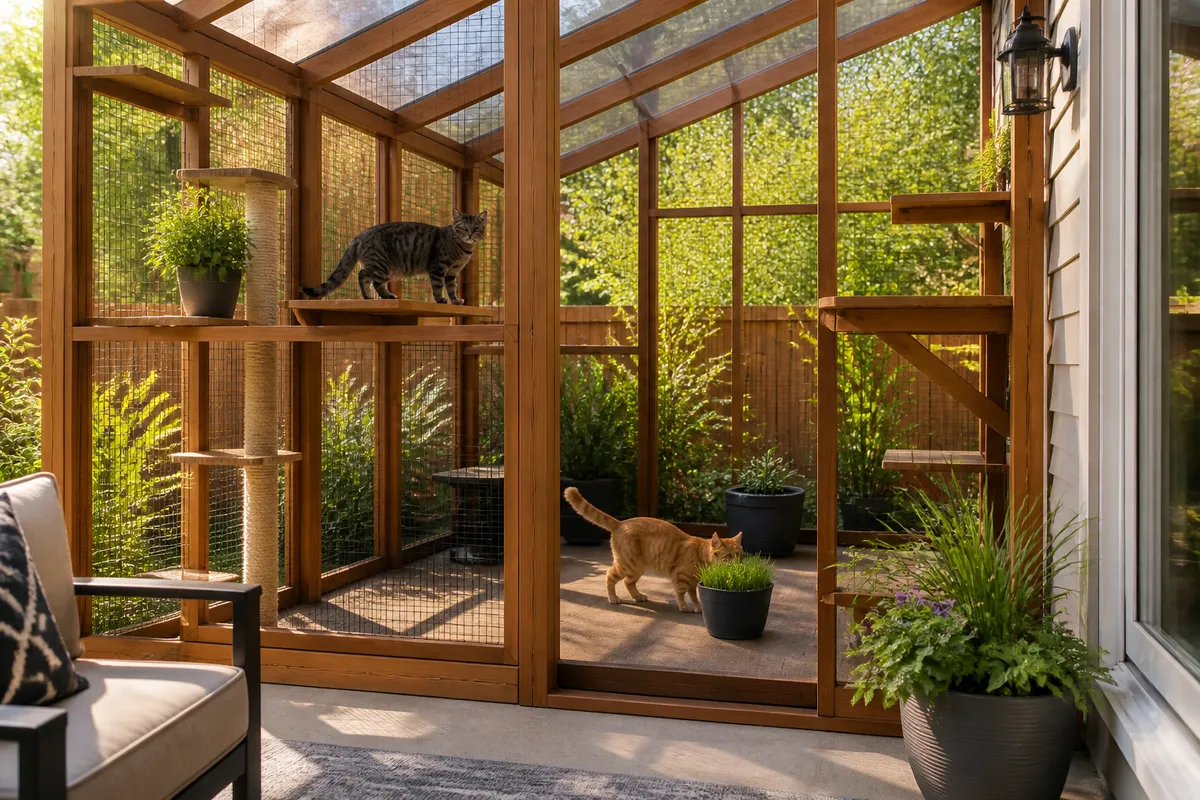
A catio is a secure, screened outdoor space that lets an indoor cat enjoy fresh air, birdsong and sunshine without the risks of roaming, and it can be anything from a small window box to a fenced yard. The right choice depends on your space, budget and how determined your cat is to escape. Safety details matter more than size.
What is a catio, and why build one?
The word is a mix of cat and patio. Humane World for Animals describes catios as screened porches designed for cats that provide enrichment and a safe way to spend time in nature. Best Friends Animal Society adds the safety side: a catio lets an indoor cat enjoy the outdoors without the danger of being attacked by another animal, struck by a car, lost or stolen.
It's also good for your neighbors with feathers. Humane World lists protecting wildlife from free-roaming cats as one of the top reasons for a catio, alongside novel smells, sights and sounds for your cat.
International Cat Care (iCatCare) notes a downside of strictly indoor life: cats may see neighborhood cats outside without being able to do anything about it, which can cause frustration. A catio doesn't solve every territorial issue, but it gives a bored indoor cat a far richer world.

Catio and outdoor cat enclosure options compared
Catios can be large or small. Humane World says prices range from under 100 dollars to thousands, depending on whether you build it yourself, buy a kit or have one custom-built. Kits cost more than DIY but are a good option if you lack carpentry skills.
For apartment dwellers, the window box catio is the classic starting point: Humane World notes an outdoor enclosure can be as simple as a window box. For houses, an attached catio reached through a cat door or tunnel lets your cat come and go on its own schedule, while a walk-in catio doubles as a fresh-air room for you, too.
| Type | Best for | Things to consider |
|---|---|---|
| Window box catio | Apartments, small budgets, one cat | Must be firmly mounted; check rental rules |
| Screened balcony or patio | Apartments and condos with outdoor space | Every gap, including the top, must be closed |
| Freestanding cat enclosure | Renters, people who may move | Can be taken along; needs a secure floor |
| Attached catio with tunnel or cat door | Houses with a yard | Ideal for cats coming and going on their own |
| Cat fence on an existing yard fence | Large yards, confident climbers | All gaps sealed, trees trimmed, ongoing checks |
| Walk-in catio room | People who want to sit outside with their cat | Human-sized door, room for a chair, higher budget |
Cat fence systems for the whole yard
If you want your cat to use the whole yard, a cat fence turns your existing fence into an enclosure. The Cat Protection Society of New South Wales, an Australian cat charity, describes the main options in its fencing factsheet: netting added to an existing fence, fence-top devices such as rollers that cats can't grip, and fully enclosed netting runs.
The groundwork comes first. Before adding anything on top, the charity advises sealing all gaps and holes in or under the fence and trimming trees and shrubs near the fence that a cat could use as a launch pad. If other animals dig under your fence, you may need ground-level guards too.
Trees inside the yard are the sneaky escape route. Cat Protection suggests metal or weatherproof plastic bands around large trunks so cats can't climb them, as a rough guide about 2 feet (600 mm) wide and placed about 8 feet (2.5 m) off the ground, or higher than your cat can jump. The alternative is running the netting around trees so they sit outside the enclosure. The charity also recommends talking to your neighbors before you start, since fence-top additions affect them too.
- Seal gaps under and between fence boards
- Trim or band trees and shrubs near the fence line
- Add netting or a fence-top roller along the entire perimeter
- Check gates and corners, the classic escape points
- Supervise your cat closely for the first weeks
Planning your catio: questions to answer first
A little planning saves a lot of rebuilding. Humane World suggests asking yourself what you want from the catio, what your budget is, whether you want direct access through a window or door or a freestanding structure, and how much yard space you can give up.
Then check permissions. If you rent, ask your landlord or management company. Humane World notes that some cities or homeowners associations require a permit. Cat Protection points out that freestanding enclosures are the best option if you don't own your home, because you can take them with you when you move.
Finally, think about local wildlife. Humane World warns that if there are coyotes, bears or other large predators in your area, a catio may not be right for you unless it's extremely sturdy.
Building a safe catio
Cats are great climbers and sometimes wily diggers. Escape-proofing is the single most important design goal.
- Close the top: Best Friends recommends chain link, hardware cloth or strong shade cloth securely attached to the sides
- Secure the floor: a firm base of at least hardware cloth keeps your cat in and other animals out, according to Best Friends
- No gaps: Humane World stresses there should be no openings a cat could squeeze through, even on top
- No snags: avoid anything that could catch a collar
- Strong frame: all parts firmly attached, with a roof that can handle your local snowfall
- Human access: a door to the outside for cleaning and emergencies, ideally human height
- Visibility: build it where you can see it from the house, and add lighting if your cat uses it at night
What to put inside a catio
A bare cage is not a catio. Best Friends and Humane World both recommend making it comfortable and interesting, with protection from the weather.
Be careful with plants. Many popular garden and patio plants are toxic to cats, including lilies. Check every plant against the ASPCA's list of toxic and non-toxic plants before it goes inside or within paw's reach. If your cat chews something questionable, call your vet or the ASPCA Animal Poison Control Center at (888) 426-4435 (a consultation fee may apply).
- Fresh water in a sheltered spot
- Shade for hot days and a cozy, dry retreat from rain and cold
- A litter box sheltered from rain, or easy access back inside
- Shelves, perches, a weatherproof cat tree or a hammock
- Logs or posts for scratching
- A tray of cat grass
- Bird feeders nearby, but not inside the catio

Common catio mistakes
Most catio problems show up in the first weeks, so it pays to know them in advance.
- Forgetting the roof: cats will climb any open side, including straight up
- Leaving gaps at corners, doors or where the catio meets the house
- No shade or shelter, so the catio becomes a hot box in summer
- Toxic plants in pots or growing through the mesh
- Building it out of sight, so you can't keep an eye on your cat
- Assuming it's escape-proof without testing it while your cat is supervised
Introducing your cat to the catio
Pick a quiet time and let your cat explore at its own pace. Humane World suggests sprinkling catnip or scattering treats if your cat is hesitant, and a bird bath or fountain nearby for extra entertainment.
Supervise, especially at first. Cat Protection notes that some cats find ingenious ways to beat an enclosure that the designer never imagined, and some simply prefer to be inside with you. Watch the first sessions closely and fix any weak spot right away.
Mind the weather. Best Friends advises providing shade so your cat doesn't overheat in summer, and not leaving your cat out in a stand-alone structure in very cold weather unless it can get back to a heated room. An outdoor cat also needs more food to stay warm in chilly weather if it spends a lot of time out there.
Frequently asked questions
How much does a catio cost?
Humane World for Animals says catios range from under 100 dollars to thousands. DIY builds are cheapest, kits cost more but need fewer skills, and custom-built catios are the priciest.
Do I need a permit for a catio?
Sometimes. Renters need landlord approval, and some cities or homeowners associations require a permit or approval, so check before you build.
What is the difference between a catio and a cat enclosure?
Not much. Catio usually means a screened space attached to or near the house, while cat enclosure is the broader term that also covers freestanding runs and fully netted yards.
Does a cat fence really work?
It can, if every gap is sealed, nearby trees are trimmed and the netting or roller runs along the whole perimeter. Supervise your cat at first, because determined climbers find weak spots.
Can my cat stay in the catio all day?
Only if it has shade, water, shelter and a way back inside or into a heated room in bad weather. Most owners use the catio while they're home and can keep an eye on it.
What is the best catio for an apartment?
A window box catio or a fully screened balcony is usually the easiest option. Check your lease and building rules first, and make sure the structure is firmly mounted and closed on all sides.
Sources
- Catios: Safe Outdoor Enclosures for Cats, Humane World for Animals
- Outdoor Catio Ideas: What You Need to Know, Best Friends Animal Society
- Factsheet: Cat-proof fencing and enclosures, Cat Protection Society of NSW
- Should I keep my cat indoors or allow outdoor access?, International Cat Care
- Toxic and Non-Toxic Plants: Cats, ASPCA
Last reviewed: November 2026