Gray Cat: Why Cats Turn "Blue" and the Breeds That Are Always Gray
Coat Colors & Patterns 5 min read reviewed November 2026, 6 sources
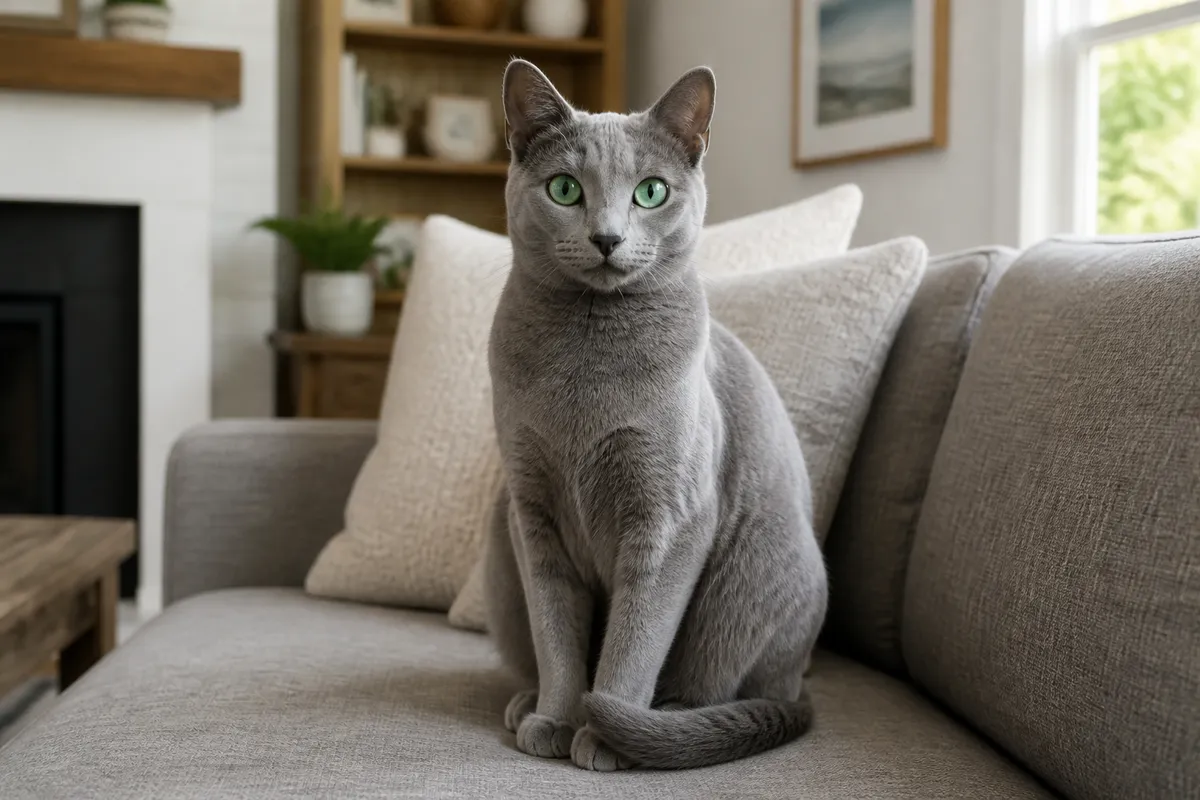
A gray cat is genetically a black cat with a dilution gene that spreads the pigment unevenly in each hair, which is why breeders call the color blue. You'll find it in everyday domestic shorthairs, in many pedigreed breeds, and in four breeds that come only in gray.
What makes a cat gray?
Gray starts out as black. The UC Davis Veterinary Genetics Laboratory explains that the dilution gene causes an uneven distribution of pigment in the hair shaft, which dilutes all colors. Instead of being packed densely, the pigment clumps, so more light passes through the hair and the coat looks gray.
Dilution is recessive. A cat needs two copies to look diluted, so two black parents that each carry one hidden copy can surprise you with a gray kitten. The same gene works on other colors too: it turns orange into cream and chocolate into lilac. A dilute calico, for example, is cream, blue and white instead of orange, black and white.
- Black plus two dilution genes: gray (blue)
- Orange plus two dilution genes: cream
- Chocolate plus two dilution genes: lilac
- One dilution gene: no visible effect, but can be passed on

Gray, grey, blue or Maltese? What the names mean
Gray (American spelling) and grey (British spelling) describe the same coat. Breeders, cat shows and registries call it blue, which can confuse anyone expecting a cat the color of a swimming pool.
You may also hear older relatives call a gray cat a Maltese cat. Vocabulary.com defines the term as one "applied indiscriminately in the United States to any short-haired bluish-grey cat." It's a nickname for the color, not a breed, and it has nothing to do with Maltese dogs.
Silver is something else again. A silver cat looks gray from across the room, but it has its own separate genetics, a bright, almost white base and darker tips. Gray and silver tabbies have their own guide.
Gray cat breeds: the four that are always gray
Most gray cats are domestic shorthairs, but four breeds come only in gray. Each has its own look and temperament, so it's worth knowing which is which.
| Breed | Origin | Coat and eyes | Temperament (per breed registry) |
|---|---|---|---|
| Russian Blue | Believed to come from the Archangel Isles, northern Russia | Short, silvery-gray coat, emerald-green eyes | Clever, may seem shy at first, then affectionate |
| Chartreux | France, selective breeding from the 1920s | Dense, water-repellent blue-gray coat, copper to gold eyes | Quieter than most breeds, calm and playful |
| Korat | Thailand, recorded in a manuscript from the Ayudhya period | Short, silver-tipped blue coat, peridot-green eyes, heart-shaped face | Energetic, affectionate, wants to be head of the family |
| Nebelung | United States, first registered cats born 1984 and 1985 | Silky, medium-long blue coat with silver tips, green eyes | Loving with family, may be shy with strangers |
Getting to know the gray breeds
The Russian Blue is the one most people picture. The Cat Fanciers' Association (CFA) calls it one of the cleverest of all breeds, easy to care for and content without a lot of space. It may seem shy with new people but quickly becomes affectionate. The CFA also warns that Russians have large appetites, so watch the portions. They're medium-sized: the CFA says males rarely exceed 10 pounds and females range from 5 to 8 pounds.
The Chartreux is the sturdy French option. Legend has it the breed lived with silent monks, and while that story is a charming myth, the CFA confirms Chartreux are quieter than most cats. Males are much larger than females and slower to mature. Kittens may show faint "ghost barring" that fades as they grow up.
The Korat is Thailand's good luck cat, traditionally given to brides and, per the CFA, rare even in its home country. According to the CFA, it takes two to four years to reach full maturity and thrives on interactive toys and attention. Expect it to consider itself the boss.
The Nebelung is the longhaired cousin. The American Cat Fanciers Association says the name comes from the German word for mist, and breed founder Cora Cobb chose it for the silver-tipped coat. It's rare, so be prepared for a wait if you want one.
Other breeds that come in gray
Blue is an accepted color in many breed standards. In CFA standards you'll find solid blue British Shorthairs, Persians, Maine Coons and American Shorthairs, among others. The British Shorthair in particular is so often blue that many people assume it's a gray-only breed. It isn't: the standard also accepts black, white, cream, tabbies and more.
If you're shopping for a gray kitten from a breeder, ask whether the color is guaranteed. Because dilution is recessive, a breeder can only promise blue kittens when both parents are blue.
Grooming needs differ by breed, not by color. The CFA describes Chartreux as seasonal shedders with a dense, woolly coat and says they are not recommended for allergy sufferers, while Korats have a single coat that sheds only lightly.
Gray and white cats
A gray and white cat is a dilute version of the classic black and white bicolor. The gray comes from dilution, the white from a separate white spotting gene that leaves some areas without pigment. White can show up as a small chest patch and paws, a tuxedo-style bib, or large areas with gray only on the head and tail.
Gray and white cats come in any breed or mix that carries both genes, and they can be male or female. Their care is exactly the same as for any other cat. If you're trying to describe one on a lost-cat flyer or to a vet, note where the white sits (chest, paws, face blaze), because "gray and white" alone fits a lot of cats.

Gray kitten: what to expect as it grows
If you bring home a gray kitten of one of the gray breeds, be patient with the final look. CFA standards allow for faint ghost tabby markings in Korat kittens and ghost barring in Chartreux kittens, plus tail rings in Chartreux under two years. These usually fade as the adult coat comes in.
Eye color takes its time too. The CFA notes that Korat kittens and adolescents can have yellow, amber or amber-green eyes, and the luminous green is usually not reached until the cat is two to four years old. In Russian Blues, the green deepens with age.
Size and build also mature slowly in some gray breeds. Chartreux take three to five years to reach maturity, and males may weigh as much as 14 pounds, while females are significantly smaller. Korats reach full maturity at two to four years. For a domestic gray kitten, plan on the usual kitten timeline and see our kittens guide.
- Ghost stripes in gray kittens: normal, usually fade
- Kitten eye color: often changes over the first years
- Grooming: Russian Blues need combing two or three times a month, Korats weekly brushing
- Chartreux: seasonal shedders with more grooming needed in fall and spring
Frequently asked questions
Why are gray cats called blue?
Blue is the traditional cat show and breeder term for diluted black. Under the dilution gene, the pigment clumps unevenly in the hair, so black looks like a soft gray with a bluish tone.
What breed is my gray cat?
Most gray cats are domestic shorthairs or longhairs of mixed ancestry. The Russian Blue, Chartreux, Korat and Nebelung are always gray, and many other breeds can be gray, but only papers or a DNA panel can confirm a pedigree.
What is a Maltese cat?
Maltese is an old American nickname for any short-haired bluish-gray cat. It describes the color, not a breed.
Is a gray cat the same as a silver cat?
No. Gray comes from the dilution gene acting on black. Silver comes from a separate gene that removes warm tones from the hair, which gives the coat a bright, almost white base.
Can two black cats have a gray kitten?
Yes, if both parents carry one hidden copy of the dilution gene. Each kitten then has about a one in four chance of getting two copies and turning out gray.
Which gray cat breed is best for an apartment?
The CFA says Russian Blues don't need a lot of space to feel content and need little grooming, which makes them a popular apartment choice. Korats are also compact but crave attention and play, so they suit people who are home often.
Sources
- Feline Coat Color, UC Davis Veterinary Genetics Laboratory
- Russian Blue breed profile, The Cat Fanciers' Association
- Chartreux breed profile and standard, The Cat Fanciers' Association
- Korat breed profile, The Cat Fanciers' Association
- Nebelung breed standard, American Cat Fanciers Association
- Maltese cat definition, Vocabulary.com
Last reviewed: November 2026